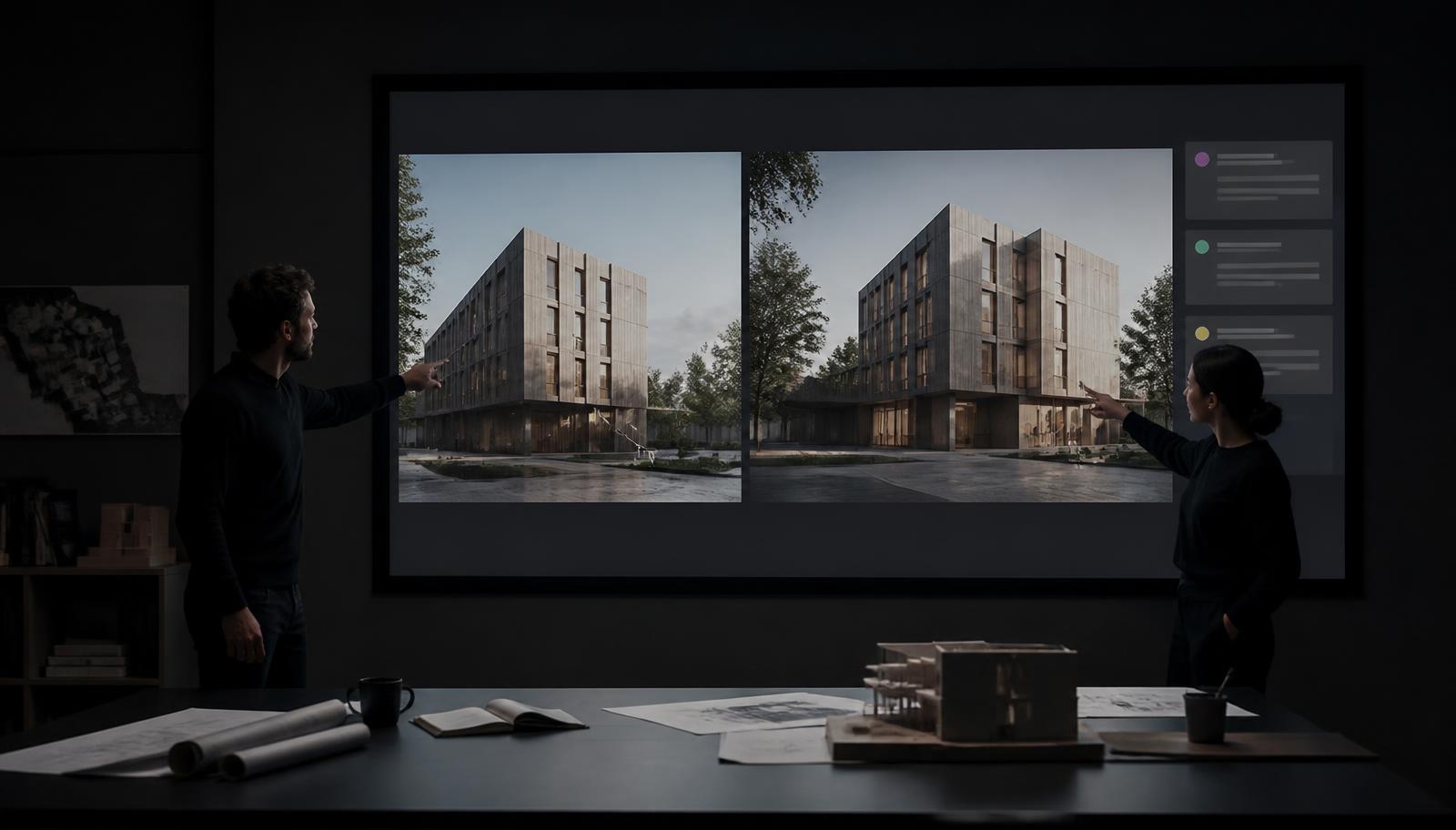
From Render to Reality: How the Gendo × Material Bank Partnership Is Closing the Gap Between Design and Specification
Gendo Team
22 June 2026
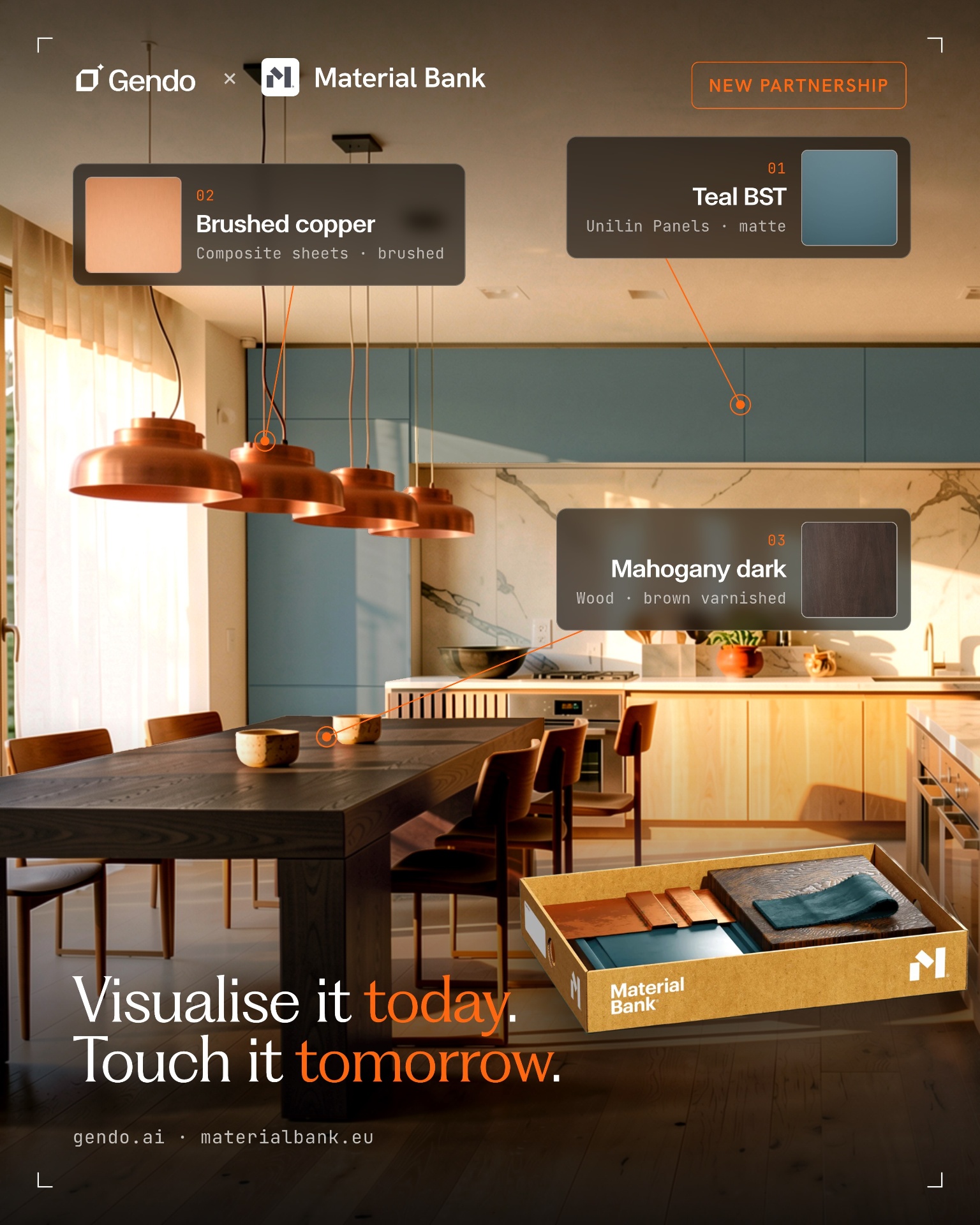
AI can produce a beautiful image in seconds. But you can't build a room out of "magical AI materials." At some point the velvet on the sofa, the timber on the slats and the tile on the backsplash have to be real things you can touch, source and specify.
That's the gap the new partnership between Gendo and Material Bank is built to close. In a recent live webinar, Gendo CEO and co-founder George Proud and Material Bank's Head of Europe, Marc Solsona Bernet, walked through how the two platforms now work together — letting architects and designers apply real, orderable manufacturer materials directly inside their AI visualisation workflow, then order physical samples for next-day delivery in a few clicks.
Here's what they showed, and why it changes how studios move from concept to specification.
Two platforms, one workflow problem
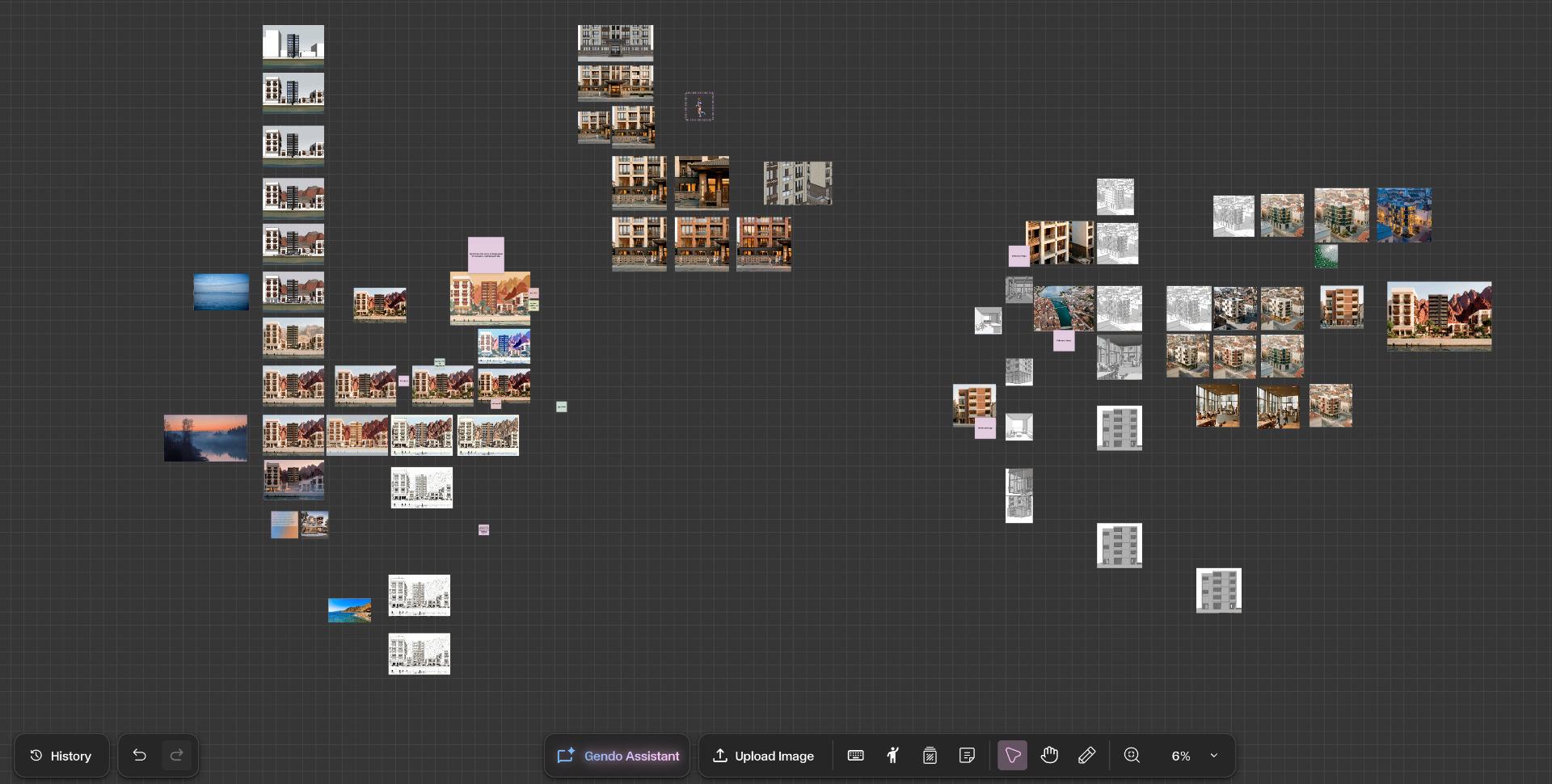
Gendo is a browser-based collaborative AI canvas built for architects and interior designers. As George put it during the session, all the AI complexity — close to fifteen or sixteen models running under the hood — is abstracted behind a simple interface, so studios can focus on design decisions instead of data pipelines and model selection. You bring your sketches, SketchUp or Revit exports, or photographs, and Gendo represents that design intent accurately, at a high level of detail and control.
Material Bank solves a different but adjacent problem: getting real materials into designers' hands quickly. As Marc described it, Material Bank is "at the core of connecting the design community with the material manufacturers, and really giving the design community access to the latest, most sophisticated… catalogue of materials available." The broader mission, he said, is "bringing material knowledge and making material decisions easier for everybody in the industry."
Why now? Marc pointed to a shift in how studios actually work. "We spend less time together in the office, we're meeting less face-to-face, and digital access and seamless access to materials is still needed and relevant. That's why we think Material Bank is perfect and was truly built for this moment."
Individually, each platform is powerful. Together, they connect inspiration to specification — closing the loop between an AI render and a buildable, specified project.
What Material Bank actually does
Founded in the US in 2019 and launched in Europe in 2024, Material Bank digitises the material library you'd find in any architecture or interior design studio. It consolidates "the product catalogue from thousands of manufacturers in one single website" so you can search, compare and request real samples — and, crucially, receive them the next day.
The value shows up against the old way of doing things. "Imagine you're working on a project and you want to get five, seven different material samples," Marc said. "It generally takes multiple calls to different brand reps… you need to track five different shipments, they arrive at different times, and it's really a very tedious process." Material Bank collapses that into a single delivery: "Everything gets delivered in one simple box. We do that overnight… they get delivered to you next day, as if it was a mood board."
A few numbers from the session that stood out:
- Next-day delivery powered by two major logistics facilities (Memphis, Tennessee and Paris) and a close partnership with FedEx. In Europe, you can order until 5:30pm London time and receive samples the following morning.
- Free for design professionals. "Material Bank is a free platform for design professionals… there's no charge whatsoever. We work on behalf of the brand manufacturers." Samples are restricted to registered professionals.
- Global scale, shipping to 38 countries, with around 50,000 registered designers in Europe and roughly 140,000 globally. Last year the platform handled over 17 million searches.
- Deep catalogue, with more than 45,000 references in Europe alone, spanning flooring, wallcoverings, surfaces and FF&E.
Marc also previewed the MTAC — an NFC chip embedded in every sample shipped, already live in North America and arriving in Europe later this year. It answers a frustration he hears constantly: "I have hundreds of samples in my studio, I don't even remember when I ordered them. Who's the person I should contact?" With MTAC, "you simply take the phone, you tap the sample, and you get all of that" — brand, pricing, availability and full technical specs.
On the partnership itself, Marc was clear about where it fits: "We're very excited to be partnering with Gendo so that design decisions are easier, and they can also be made in a rendering context, a 3D context — and hopefully, as we move forward, we can also integrate in the future augmented reality."
The integration, live in the Gendo canvas
The heart of the webinar was George's live demo of Material Bank inside Gendo.
A new icon in the Gendo toolbar opens the material catalogue — currently around 16,000 assets from over 50 brands. Rather than mirroring the Material Bank website, it's reorganised for design work: browse by colour and category, filter by finishes, textures and colour groups, then drag a material onto the canvas to start using it like any other asset.
The standout tool is Edit Material. Unlike Gendo's general Edit feature, which can deviate from your architecture, Edit Material is designed to maintain the geometry already in your scene — keeping everything architecturally consistent while swapping out the surface.
George ran through several examples:
- Swapping a sofa's fabric to a Schumacher velvet, with nothing else in the image changing — same sofa, new material.
- Applying a new timber to vertical slats with the simple prompt "dark timber vertical slats," matched to the existing geometry.
- Dropping a terrazzo onto a floor with a glossy, reflective finish, and tiles onto a kitchen backsplash, all pulled straight from the Material Bank catalogue.
The key point: a Material Bank asset behaves exactly like any other asset in Gendo. There is no special workflow to learn. And when you've found the material you want, one click on the Material Bank button takes you straight to that product on the Material Bank site, where you add it to a project, check out and order a free physical sample.
George also touched on Gendo's new Video capability, which animates a still render into short MP4 clips — from controlled camera moves (walk forward, pan, time-lapse) to creative options like a cinematic multi-shot edit or a custom A-to-B transition. In one example, a clip revealed a new floor material sweeping across the room; in another, a time-lapse carried a scene from day into evening. Any interim frame can be saved back to the canvas to keep iterating.
A genuine two-way street with brand reps
One question from the audience cut to a real anxiety: if I order through Material Bank, am I bypassing the brand reps I already work with?
Marc was emphatic — no. "Material Bank is just a technology layer. We don't sell anything, we just put you in contact with the brands. So everything you do inside Material Bank, your brand will have knowledge of." Every order shares project details directly with the manufacturer, and you can message your brand rep through the platform about pricing, lead times or install images. Far from cutting reps out, he noted, "the brands love Material Bank because it helps their sales teams get organised."
Other useful takeaways from the Q&A:
- Samples are for professionals only. You can split an order across up to three shipping destinations — handy for sending materials to your office, a collaborator and a client at once.
- The catalogue grows weekly. Material Bank is onboarding new brands constantly, with "a pipeline of around 60 manufacturers" still to come.
- US and Europe currently run as two separate catalogues (certifications and distribution differ by region), with a unified global platform in the works. In Gendo, the EU catalogue is live for everyone to visualise with; physical sample ordering is EU-only for now.
- Client-ready mood boards. Designers already keep Gendo open in meetings with clients, planning officers and stakeholders to reach alignment in the room — far faster than the traditional back-and-forth of visualisation cycles.
What's coming next
George closed with a look ahead. In the near term, Gendo is shipping material rotation and scale controls so you can fine-tune how a texture sits in a space, plus presentation tools like frames and text, a fix for image degradation across heavy iterations, and custom styles. The longer-term ambition is to make Gendo less about producing single images and more about the whole design process — integrating more closely with CAD, drawings and partners like Material Bank so design decisions and specification live in one place.
For Material Bank, this partnership marks a turning point. "Material Bank has been operating for seven years. We've mostly been focused on building our physical infrastructure and logistics," Marc reflected. "We're super excited to now really be looking into the digital part of the business" — making the catalogue available "with more advanced digital capabilities: rendering, AR and everything that's coming next."
He ended on a warm note about the collaboration: "I've been using Gendo quite a bit lately… and it's impressive to see what you've built. Very proud to be working together."
Why this matters for architects and interior designers
The story underneath this partnership is simple: AI rendering has been disconnected from real-world specification for too long. A generic AI image might look stunning, but if the materials aren't real, orderable or specifiable, the render stalls at "nice picture."
Bringing Material Bank's catalogue inside the Gendo canvas closes that loop. You can now:
- Visualise real manufacturer materials in context, not generic textures.
- Move from inspiration to physical sample in clicks, with next-day delivery in Europe and the US.
- Keep your specification trail intact, with orders flowing through to the actual brand reps you already work with.
- Run the whole journey on one canvas — sketch, render, material edit, video walk-through, sample order — without ever leaving Gendo.
That's the gap this partnership is built to close: not just better renders, but renders that translate cleanly into buildable, specified, signed-off projects.
Try the Material Bank integration inside Gendo's collaborative AI canvas, or learn more about how Material Bank works with Gendo.